

September 3, 2026
Vinyl Flooring Thickness Guide & Chart (mm)
Choosing vinyl flooring thickness can stall a whole renovation. Planks and tiles run anywhere from 2mm to 8mm or more, wear layers get quoted in mils and millimetres, and every brochure swears its number is the right one.
Here is the short version. Unlike toilet paper, where 4 ply reigns supreme, thicker is not always better when it comes to vinyl. What matters most is the wear layer, the condition of your subfloor and where the floor is going.
Quick answer: for most WA homes, a 4mm to 6mm click vinyl plank with a wear layer of at least 0.3mm (12 mil) is the sweet spot. For commercial spaces, step up to a 0.55mm (20 mil) wear layer or more. Glue-down planks and sheet vinyl are thinner, usually 2mm to 3.5mm, because the adhesive does the stabilising work.
Vinyl flooring thickness at a glance
The right thickness depends on the format. This table shows the typical ranges you will see in Australian stores and what each format suits best.
| Vinyl format | Typical overall thickness | Best suited to |
|---|---|---|
| Sheet vinyl | 2mm to 3.5mm | Wet areas, healthcare, kitchens and laundries |
| Glue-down vinyl planks and tiles (LVP and LVT) | 2mm to 3mm | Commercial fitouts and renovations where floor height matters |
| Click or loose-lay vinyl planks Most homes | 4mm to 6.5mm | DIY-friendly installs over existing floors |
| Hybrid and rigid-core planks | 5mm to 8mm and up | Busy family homes and uneven subfloors |
Overall thickness is only half the story though. The number that actually determines how long your floor keeps looking good is the wear layer.
Overall thickness vs wear layer: the number that matters
A vinyl plank is built in layers: a backing for stability, a core, the printed design layer, and a clear protective coating on top called the wear layer. That top coating is what stands between your floor and scratches, scuffs, stains and dents.
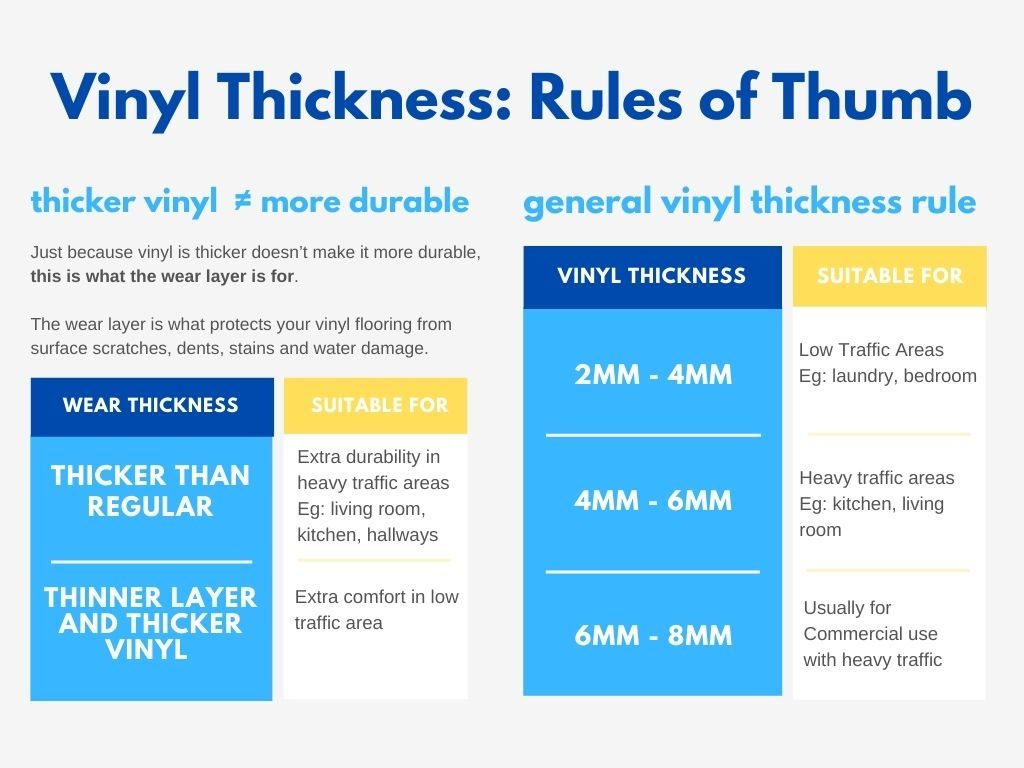
Overall thickness, the 4mm or 6mm figure on the box, affects how solid and quiet the floor feels underfoot and how well it copes with minor subfloor imperfections. The wear layer determines how long the surface lasts. A 6mm plank with a thin 0.1mm wear layer will show wear far sooner than a 4mm plank wearing a 0.55mm coat.
| Wear layer | Also sold as | Where it belongs |
|---|---|---|
| 0.1mm to 0.2mm | 4 to 8 mil | Low-traffic bedrooms and guest rooms |
| 0.3mm Most homes | 12 mil | Living areas, kitchens and hallways in most homes |
| 0.55mm | 20 mil | Shops, offices, cafes and very busy households |
| 0.7mm | 28 mil | Heavy commercial spaces with constant foot traffic |
If a retailer quotes mils rather than millimetres, divide by 40 for a rough conversion: 12 mil is about 0.3mm and 20 mil is about 0.5mm.
So why does vinyl thickness matter?
Before you settle on a number, ask yourself the following questions:
- Where is it being installed?
- Will there be a lot of foot traffic?
- What type of subfloor is it going on top of?
- What is the condition of the subfloor?
- What type of vinyl are you choosing?
Answer those five and the right thickness usually picks itself. A busy cafe entry and a spare bedroom should never wear the same spec.
How does the subfloor affect vinyl thickness?
The condition and type of your subfloor plays a big role in the thickness you need. Vinyl is flexible, so over time it can telegraph whatever sits underneath it: high spots, dips and joints in the subfloor may eventually show through a thin floor.
A thicker, more rigid plank bridges minor imperfections better and feels more stable underfoot. It is not a substitute for preparation though. Whatever thickness you choose, your subfloor should be clean, dry and level before anything goes down. If you are laying over old tiles or an uneven slab, a levelling compound or a thicker rigid-core plank, or both, will save you grief later.
Types of vinyl flooring
Thickness guidance changes with the format, so here is how the three main types compare.
1. Luxury vinyl planks (LVP)
Long boards that mimic timber. Glue-down versions sit around 2mm to 3mm and rely on adhesive for their stability, which makes them a favourite in commercial fitouts. Click and loose-lay versions run 4mm to 6.5mm and float over the subfloor, which makes them the DIY favourite.
Browse our luxury vinyl plank range, or for fitout specs see our commercial vinyl planks and tiles page.

2. Luxury vinyl tiles (LVT)
The same construction as LVP, cut into tile formats that suit stone and ceramic looks. Thickness ranges match their plank equivalents: 2mm to 3mm for glue-down and 4mm to 6mm for click versions. In commercial venues, LVT with a 0.55mm wear layer is the standard workhorse.

3. Vinyl sheet
Supplied in wide rolls with few or no seams, usually 2mm to 3.5mm thick. The continuous surface is why hospitals, aged care and wet areas rely on it. Repairs are the trade-off: damage means patching in a new piece or replacing the sheet, so a decent wear layer matters here too.
See our commercial and sheet vinyl range for options.

Shopping for something more rigid? Hybrid flooring is vinyl’s stiffer cousin: a 5mm to 8mm rigid-core plank that handles uneven subfloors and busy households well.
What thickness do commercial floors need?
Commercial spaces punish floors with constant foot traffic, castor chairs, trolleys and the odd dropped carton. For shops, offices and hospitality, treat a 0.55mm (20 mil) wear layer as your baseline, and step up to 0.7mm (28 mil) for entries, corridors and high-turnover venues.
Glue-down LVP or LVT around 2.5mm suits most fitouts, while sheet vinyl suits healthcare and wet areas. Our commercial team supplies and quotes both: start with the commercial vinyl planks and tiles or commercial vinyl sheet pages.
The verdict
If you are installing vinyl in a high-traffic area, choose a thicker floor with a serious wear layer. It will give you more stability, comfort and years of service. Thicker planks also cope better with imperfect subfloors, though nothing beats getting the subfloor clean, even and dry first.
When you are comparing products, ask your rep as many questions as you like: wear layer, overall thickness, backing type and what the warranty actually covers for your space.
Still weighing it up? Contact our team or head into your nearest Jupps store and we will help you match a thickness to your project.
What is a good thickness for vinyl plank flooring?
For floating click planks in a home, 4mm to 6mm is the sweet spot. Glue-down planks are typically 2mm to 3mm and rely on the adhesive for stability, so the lower number is not a downgrade.
What wear layer do I need on vinyl flooring?
At least 0.3mm (12 mil) for the busy areas of a home, and 0.55mm (20 mil) or more for commercial spaces. Bedrooms and low-traffic rooms can go thinner.
Is thicker vinyl flooring more durable?
Not by itself. Durability comes almost entirely from the wear layer. Extra overall thickness adds stability, comfort and better coverage of minor subfloor imperfections, not scratch resistance.
What is 20 mil in mm?
About 0.5mm. Divide mils by 40 for a rough conversion: 12 mil is about 0.3mm and 28 mil is about 0.7mm.
Does thicker vinyl help with an uneven subfloor?
It bridges small imperfections better, but it is not a fix. Subfloors should still be clean, dry and level, and larger dips need a levelling compound before installation.
Ready to talk floors?
Bring your questions, measurements or photos and the team will point you to the right product for the job.
Keep reading
 FlooringHow to Get Stains Out of Carpet: The Complete Guide
 FlooringMould Under Flooring: Signs, Causes & Fixes
 FlooringHow to Lay Carpet Tiles: DIY in 7 Steps
 FlooringBest Flooring for Allergies & Asthma
 ResidentialIs Vinyl Flooring Toxic? The Facts for Aussie Homes
 FlooringHow to Protect Vinyl Flooring from Dents & Damage
 FlooringLaminate Flooring Installation: Step by Step Guide
 FlooringHow To Wash Concrete Floors

